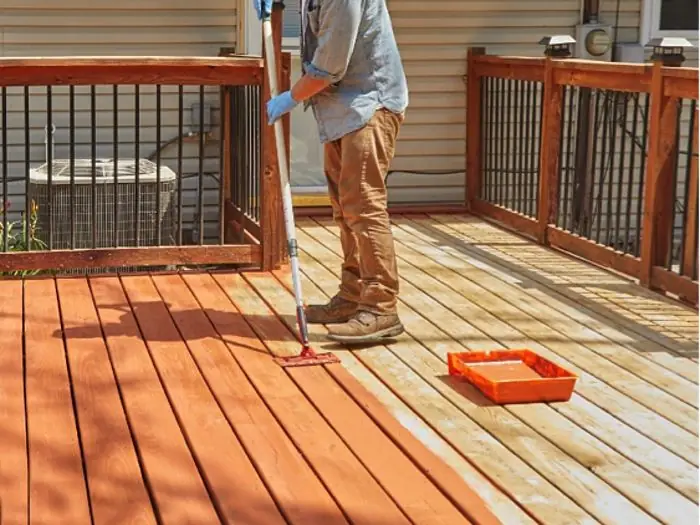
A deck up here takes more punishment than almost any other surface on a house. Direct sun at elevation, snow that sits on the boards for days, and meltwater that soaks in and then freezes overnight. Any finish will eventually give up. The question is how it gives up, because that determines what you have to do next time.
Semi-transparent stain soaks into the wood rather than sitting on top of it. It colours the boards while leaving the grain visible, and because there is no film on the surface, there is nothing to peel. It fades instead. When it is time to recoat, the deck gets washed and the new coat goes straight on. That is the great advantage: maintenance stays easy forever. The trade-off is that it fades faster, so you are recoating every two or three years in full sun.
Solid stain and deck paint both form a film on the surface. They cover the grain, they offer far more colour choice, and they last considerably longer before they need attention. The catch is what happens when they do fail. A film finish does not fade away politely — it lifts, cracks and peels, and the only way to recoat properly is to scrape and sand off everything that has let go. On a large deck that is genuinely hard work, and it comes around every time.
Here is the part that decides it for most people: you can go from stain to paint, but going back the other way is a serious job. Once a film finish is on the boards, a penetrating stain has nowhere to penetrate. If you are on the fence, starting with semi-transparent keeps both options open.
Whichever you choose, the finish only lasts if the wood is clean and genuinely dry underneath it. This is the single most common reason deck finishes fail early around here. A deck gets pressure washed, it looks dry by the afternoon, and a coat goes on the same day. But the boards have taken on water well below the surface, and that moisture is now trapped under the finish. It comes out eventually, and it takes the coating with it. After washing, a deck needs days — not hours — to dry, and longer in the shade or after a damp spell.
Two details that make the difference between a finish that lasts and one that rots from underneath: the cut ends of boards and rails drink far more than the faces do, and they are the first place water gets in, so they need coating properly rather than a quick pass. And the underside of the handrail — the surface nobody sees and most crews skip — is where water sits longest after rain. We coat both.
Before any of it, the boards need sorting out. Splintered and rough areas get sanded back, and every popped nail and proud screw gets driven below the surface. A fastener standing a millimetre above the board will wear a bare patch through any finish within a season.
Want a straight answer for your deck? Call (828) 963-0548 and we will look at what is on the boards now and give you a free written estimate.