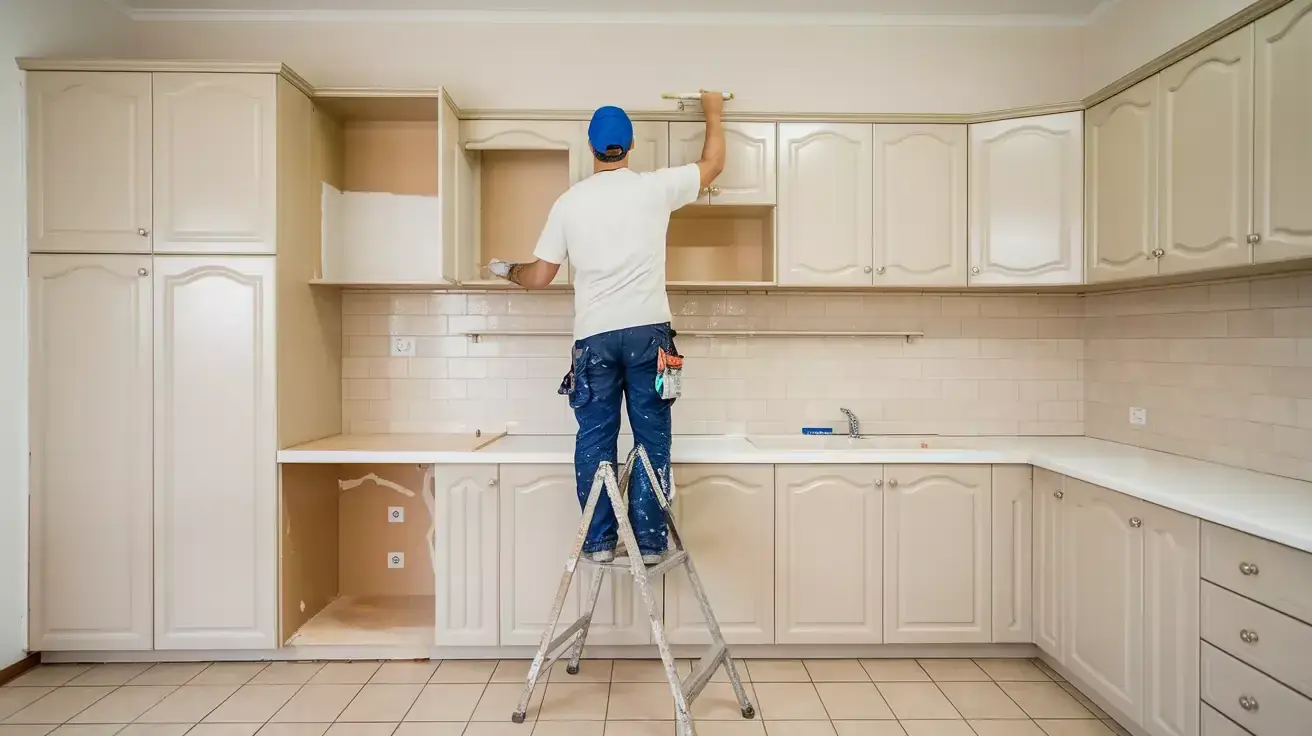
Painting kitchen cabinets is one of the best-value jobs in a house. For a fraction of what new boxes cost, a dated kitchen looks current again. It is also the job we get called in to fix most often — someone had it done two years ago, and now the finish is lifting off the drawer fronts and around the handles.
When that happens, people assume they were sold cheap paint. Almost always, they were not. The paint failed because of what was, or was not, done to the surface underneath it. Cabinet finishes fail at the bond, not at the topcoat.
The first step is degreasing, and it is the one that gets skipped most. Kitchen cabinets absorb cooking grease for years, and it builds up heaviest exactly where you would expect: the doors either side of the stove, the drawer fronts you pull with a hand that has just been cooking, and the strip of door under the range hood. Grease is invisible on a painted surface and completely impermeable to paint. A wipe with a damp cloth does not touch it. It needs a proper degreasing cleaner and some effort, and on a kitchen that has been cooked in hard it can take two passes.
The second step is scuff-sanding. Most existing cabinet finishes are a cured factory coating — a conversion varnish or catalysed lacquer — and those are engineered to be hard, slick and unreceptive. That is exactly what you want in a finish and exactly what you do not want in a surface you are about to coat. Scuff-sanding knocks the sheen off and gives the next coat a mechanical key to grip. It does not need to go to bare wood; it needs to go dull.
The third step is a bonding primer. Not a wall primer, and not the topcoat used as its own primer. A bonding primer is formulated to stick to difficult, slick surfaces and to give the finish coat something it can hold onto. This is the step that separates a cabinet job that lasts a decade from one that starts chipping the first winter.
After that, the finish itself matters less than people think, provided it is a genuine cabinet-grade enamel rather than wall paint. What does matter is cure time. Cabinet enamels reach a hard, washable cure over days or weeks, not hours. Rehanging doors too early and closing them against the frame is a good way to pull a finish that would otherwise have been fine — which is why we leave doors flat and unstacked until they have hardened properly.
One practical note for anyone doing this themselves: label everything. Doors and drawer fronts that look identical are not. They were hung and adjusted to their own openings, and swapping two of them means chasing an alignment problem across the whole run. We number the back of every door and bag the hardware with it.
Thinking about your kitchen? Call (828) 963-0548 and we will look at the existing finish and give you a free written estimate.